Notes From The Underground - II
In 1913, Vienna played host to Adolf Hitler, Leon Trotsky, Joseph Tito, Sigmund Freud and Joseph Stalin. It was a disparate group. The two revolutionaries, Stalin and Trotsky, were on the run. Sigmund Freud was already well established. The psychoanalyst, exalted by followers as the man who opened up the secrets of the mind, lived and practised on the city’s Berggasse. The young Josip Broz, later to find fame as Yugoslavia’s leader Marshal Tito, worked at the Daimler automobile factory in Wiener Neustadt, a town south of Vienna. Then there was the 24-year-old from the north-west of Austria whose dreams of studying painting at the Vienna Academy of Fine Arts had been twice dashed and who now lodged in a doss-house in Meldermannstrasse near the Danube, one Adolf Hitler. No-one knows if Hitler bumped into Trotsky, or Tito met Stalin. The conflagration which erupted the following year destroyed much of Vienna’s intellectual life. The empire imploded in 1918, while propelling Hitler, Stalin, Trotsky and Tito into careers that would mark world history forever. BBC (2013)
Mark Oleynik hopes to change the home kitchen by introducing a robot cook that is as good as a top chef but which can be installed in all houses. It can, in principle, be used to cook more or less anything: a pair of dexterous robotic hands suspended from the ceiling assemble the ingredients, mix them, and cook them in pots and pans as required, on a hob or in an oven. A prototype of the idea, unveiled in Hanover, has been demonstrating its culinary prowess in public, by whipping up an excellent crab bisque. The machine's finesse comes because its hands, human-sized and with jointed fingers and thumbs, are copying the actions of a particular human chef, who has cooked the recipe specially in order to provide a template for the robot to copy. The plan is to support the automated kitchen with an online library of more than 2,000 recipes. The Economist (2015)
I remember being rather disturbed by the sad and lonely little knots of abortion opponents we sometimes encountered at demonstrations – often hollow-faced men with severe hair and very tightly-tied ties, standing in the rain next to some glum nuns. They perfectly encapsulated what we were fleeing from, the ordered, hierarchical, self-disciplined life of the suburbs, lawn-mowing, shoe-polishing, respectable, possibly even church-going. What if we were all to be dragged back into that world, compelled by a bawling baby to take out a mortgage, live in the provinces, become a commuter, sing hymns and acquire a garden gate? No, we were destined to live in the capital, child-free, lawn-free, hymn-free, unencumbered, without obligations to our parents, and the past, or to children, and the future. Peter Hitchens (2018)
Festina lente
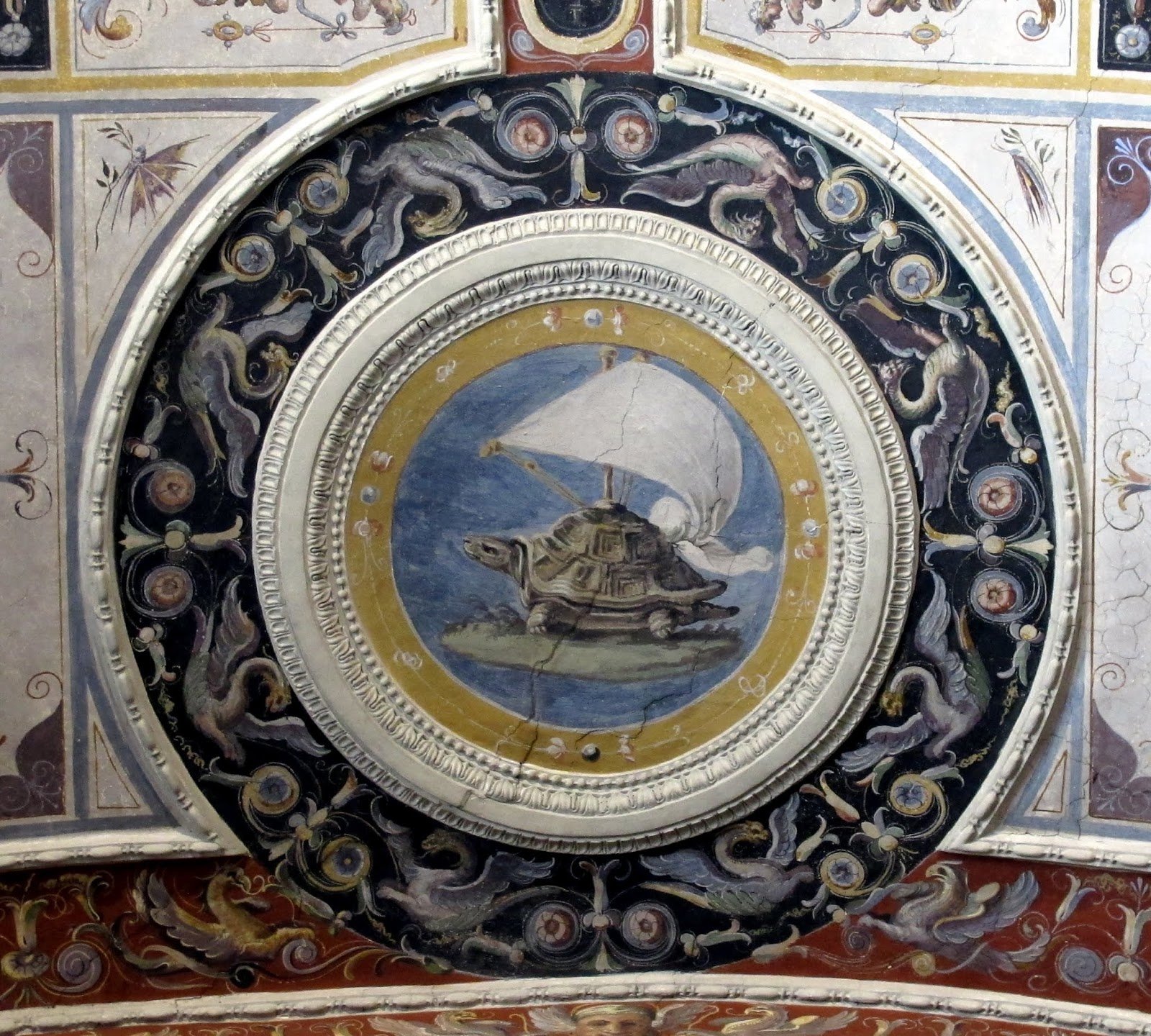 Lorenzo Sabatini (1565)
The hammer-wielding terrorist who attacked police outside the Notre Dame Cathedral in Paris was handed an award by the European Union for complaining about racism against migrants. Farid Ikken, 40, emerged from a crowd of tourists and swinging his weapon at three police officers. Now it has emerged that he had worked as a reporter in Sweden and received the EU's 'National Journalist Prize Against Discrimination'. He was given the accolade by officials in Brussels after writing an article about asylum seekers 'who are not entitled to medical care and who are therefore forced to seek shelter'. After winning the prize in 2009, Ikken said: 'it has been gratifying that attention has been paid to such important topics as discrimination and diversity.' Ikken had studied at Stockholm university, and is thought to have married a Swedish woman during his time there. He is currently enrolled as a doctoral student specialising in communication at Metz university, in eastern France. The Daily Mail (2017)
In Christianity, the doctrine of the Trinity states that God is a single essence in which three distinct hypostases ("persons"): the Father, the Son, the Holy Spirit, exists consubstantially and co-eternally as a perichoresis. Islam considers the concept of any "plurality" within God to be a denial of monotheism. Monotheism in Islam, known as Tawhid, is the religion's central and single most important concept, upon which a Muslim's entire religious adherence rests. Shirk, the act of ascribing partners to God – whether they be sons, daughters, or other partners – is considered to be a form of unbelief in Islam. The Quran repeatedly and firmly asserts God's absolute oneness, thus ruling out the possibility of another being sharing his sovereignty or nature: "There is no god except God." Wikipedia (2024)
Whereas black studies celebrates black writers and black history, and gay studies brings out gay figures from history and pushes them to the fore, ‘whiteness studies’ is far from a celebratory study.
Its aim is that it is committed to disrupting racism by problematizing whiteness.
So whereas every other field of race studies is performed in a spirit of celebration the aim of this one must be to ‘problematize’ hundreds and hundreds of millions of people.
Of course it might be said that defining an entire group of people, their attitudes, pitfalls and moral associations, based solely on their racial characteristics is itself a fairly good demonstration of racism.
For ‘whiteness’ to be problematized’ white people must be shown to be a problem.
[The Madness of Crowds: Gender, Race and Identity (2019), Douglas Murray]

I arrived in London at April, 2015. Strolling around its streets and travelling through its underground, I noticed that no culture or ethnicity was in majority. Its roots are British and it's inside England but London is London nowadays, a city-state in its own right. With more than thirteen million metropolitan inhabitants, it is preforming the unique experience of forging the ultimate Humanist utopia: despite your race, culture or religion, you are a Londoner and London is your home. It justifies its own existence not on ethnic or historical grounds, but pragmatic needs, like the availability of a Costa Coffee, a Primark or a H&M near you; united in consumerism. Although it seems that everyone is getting along, it is also true that London is putting a tremendous amount of effort and money in an Orwellian rewriting of its own White and British History: whether in pro-immigration campaigns or in social engineering of its television shows, racial fairness is not taken lightly. Its museums highlight "the first Black", "the first Muslim" and even "found" a black Roman centurion. I admire the courage of London performing such social experience but I wonder if all its communities will stand together if someday London experiences an economic doom and if yes, what will be the glue that holds them. As Murphy's Laws states: if there are two or more ways to do something, and one of those ways can result in a catastrophe, then catastrophe will happen. (2015)
“Harrison Bergeron” is a dystopian science-fiction short story by American writer Kurt Vonnegut, first published in October 1961. In the year 2081, the 211th, 212th, and 213th amendments to the Constitution dictate that all Americans are fully equal and not allowed to be smarter, better-looking or more physically able than anyone else. The Handicapper General’s agents enforce the equality laws, forcing citizens to wear “handicaps”: masks for those who are too beautiful, loud radios that disrupt thoughts inside the ears of intelligent people and heavy weights for the strong or athletic. (2020)
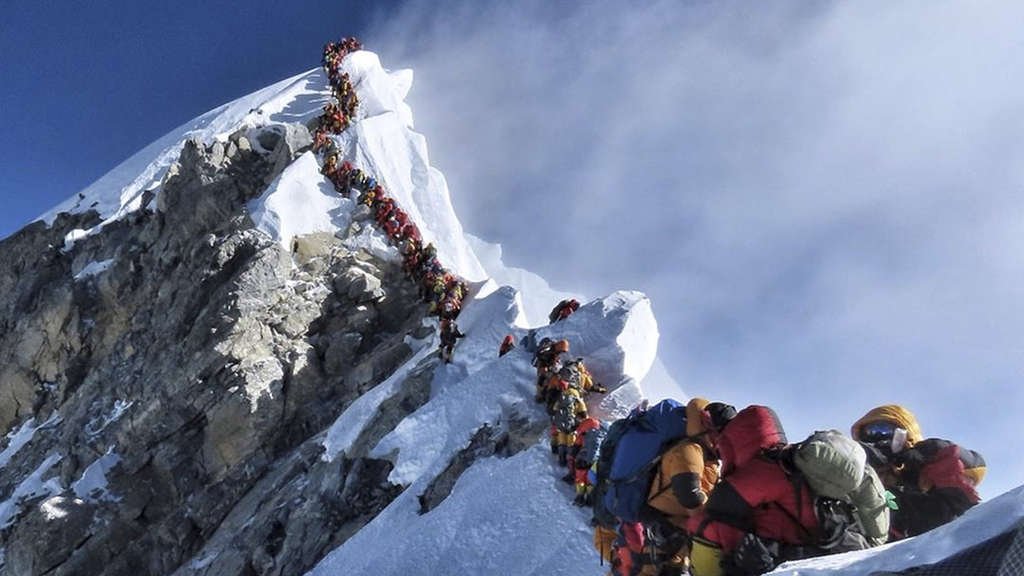
In this photo made on May 2019 (Nirmal Purja), a long queue of mountain climbers line a path on Mount Everest.
Eleven people died as climbers rushed to take advantage of five days, scattered across two weeks, when wind and storm conditions were safe enough for them to stand on the summit. (2019)
[Hedgehog's Dilemma] A number of porcupines huddled together for warmth on a cold day in winter; but, as they began to prick one another with their quills, they were obliged to disperse. However the cold drove them together again, when just the same thing happened. At last, after many turns of huddling and dispersing, they discovered that they would be best off by remaining at a little distance from one another. In the same way the need of society drives humans together, only to be mutually repelled by the many prickly and disagreeable qualities of their nature. The moderate distance which they at last discover to be the only tolerable condition of intercourse, is the code of politeness and fine manners; and those who transgress it are roughly told to keep their distance. By this arrangement the mutual need of warmth is only very moderately satisfied; but then people do not get pricked. Arthur Schopenhauer conceived this metaphor for the state of the individual in society. Wikipedia (2014)
“I built it with my hands. Straightened old nails to put the sheathing on. Rafters are wired to the stringers with baling wire. It’s mine. I built it. You bump it down—I’ll be in the window with a rifle. You even come too close and I’ll pot you like a rabbit.”
“It’s not me. There’s nothing I can do. I’ll lose my job if I don’t do it. And look—suppose you kill me? They’ll just hang you, but long before you’re hung there’ll be another guy on the tractor, and he’ll bump the house down. You’re not killing the right guy.”
“That’s so,” the tenant said. “Who gave you orders? I’ll go after him. He’s the one to kill.”
“You’re wrong. He got his orders from the bank. The bank told him, ‘Clear those people out or it’s your job.’”
“Well, there’s a president of the bank. There’s a board of directors. I’ll fill up the magazine of the rifle and go into the bank.”
The driver said, “Fellow was telling me the bank gets orders from the East. The orders were, ’Make the land show profit or we’ll close you up.’”
“But where does it stop? Who can we shoot? I don’t aim to starve to death before I kill the man that’s starving me.”
“I don’t know. Maybe there’s nobody to shoot. Maybe the thing isn’t men at all. Maybe like you said, the property’s doing it. Anyway I told you my orders.”
[Grapes of Wrath, chapter 5 (1939), John Steinbeck]
[Samuel Paty died. For what?] French president Emmanuel Macron paid his respects at the coffin of History teacher Samuel Paty, who was beheaded for having shown cartoons of the Prophet Muhammad in a civics class discussion on free speech at the junior high school where he taught in the suburb of Conflans-Sainte-Honorine, near Paris. He was killed on his way home from work after school by Abdullakh Anzorov, who published an image of the teacher's severed head on Twitter before he was himself shot dead by police. The president said Paty was slain "because he incarnated the French Republic." Macron gave the country's highest civilian award, the Legion of Honour, to Samuel Paty. (2020)
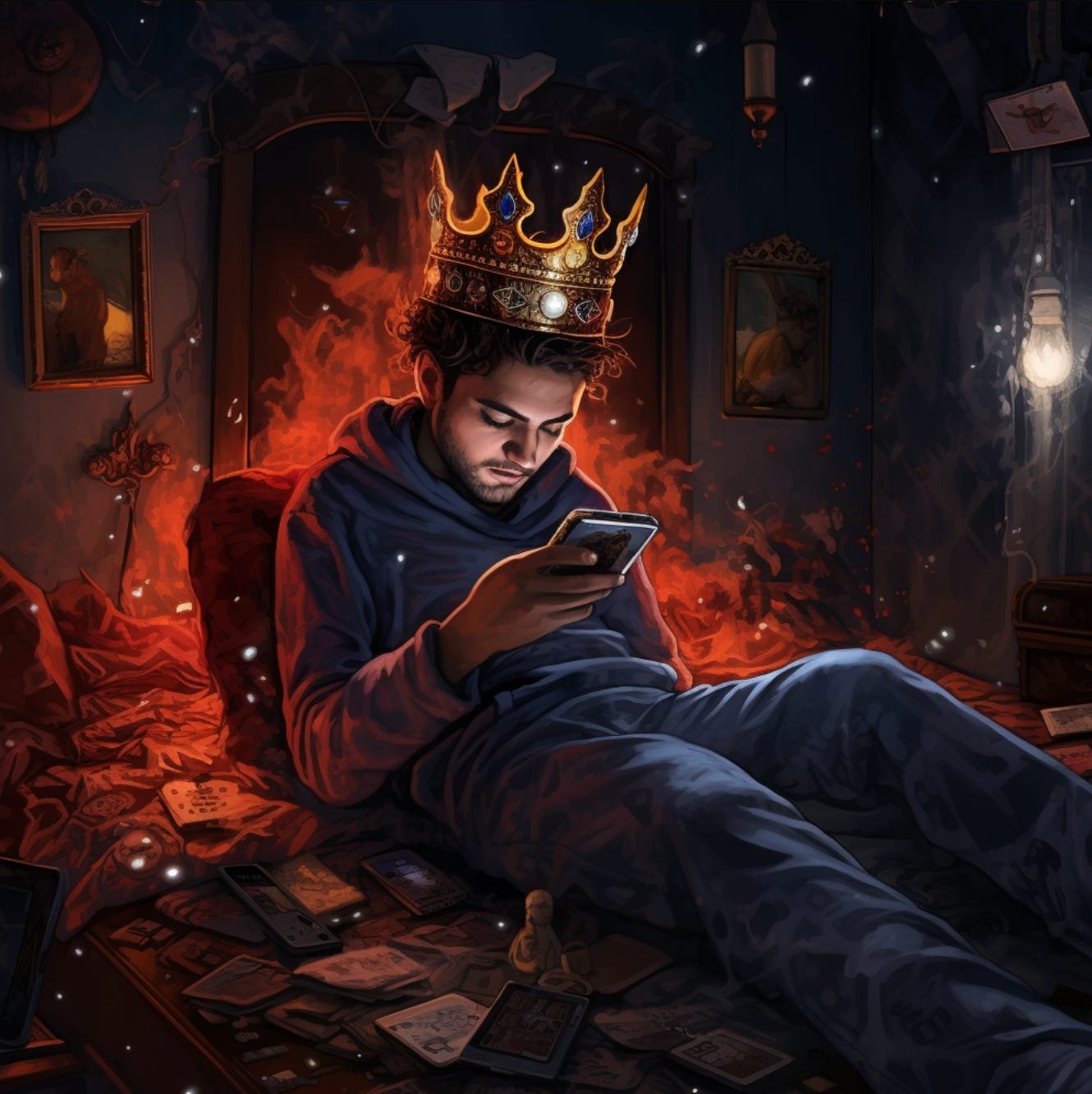 (2023)
Será este o meu fim?
Temo que sim.
E o que será da montanha, regressará alguma vez ao que foi outrora?
Não, mas enquanto o Sol brilhar sobre nós, esta montanha perdurará, mas isso não é grande consolo, pois não?
Não para nós.
[Andrómeda (2020), Zé Burnay]
Most of Iraq’s Christians call themselves Assyrians, Chaldeans or Syriac, different names for a common ethnicity rooted in the Mesopotamian kingdoms that flourished between the Tigris and the Euphrates rivers thousands of years before Jesus. Christianity arrived during the first century, according to Eusebius, an early church historian. From Greece to Egypt, this was the eastern half of Christendom, a fractious community divided by doctrinal differences that persist today: various Catholic churches, the Eastern and Oriental Orthodox, and the Assyrian Church of the East. When the first Islamic armies arrived from the Arabian Peninsula during the seventh century, the Assyrian Church of the East was sending missionaries to China, India and Mongolia. The shift from Christianity to Islam happened gradually. Much as the worship of Eastern cults largely gave way to Christianity, Christianity gave way to Islam. For 1,500 years, different religions thrived side by side. One hundred years ago, the fall of the Ottoman Empire and World War I ushered in the greatest period of violence against Christians in the region. The genocide waged by the Turks left at least two million Armenians, Assyrians and Greeks dead. Nearly all were Christian. From 1910 to 2010, the percentage of the Middle Eastern population that was Christian continued to decline: once 14 percent of the population, Christians now make up roughly 4 percent. In Lebanon, the only country in the region where Christians hold significant political power, their numbers have shrunk over the past century, to 34 percent from 78 percent of the population. Low birthrates have contributed to this decline, as well as hostile political environments and economic crisis. Fear is also a driver. The rise of extremist groups, as well as the perception that their communities are vanishing, causes people to leave. The New York Times (2015)
Did you take part in any of the mysterious commemorations last weekend? The newspapers were full of it – something called 7/7, apparently. I read a long report on the BBC’s website about this tragedy but remained entirely unclear as to who killed the people on those trains and bus. The report said ‘bombs were detonated’ on the Tube, as if the bombs – anxious to fulfil their purpose in life – had blown themselves up, without the aid of any external agency. Nowhere in the report did it mention who brought the bombs down from Yorkshire and then set them off. Nowhere in the entire article were the words ‘Islam’ or ‘Islamist’ or even ‘Muslim’ mentioned, nor even the names of the murderers. It was as if they were coincidental to the atrocity, and not worthy of consideration. Mind you, a day later there was a piece explaining how 7/7 had changed the lives of British Muslims and had made them less trustful of the white community. The Spectator (2025)
Russia's point of view.
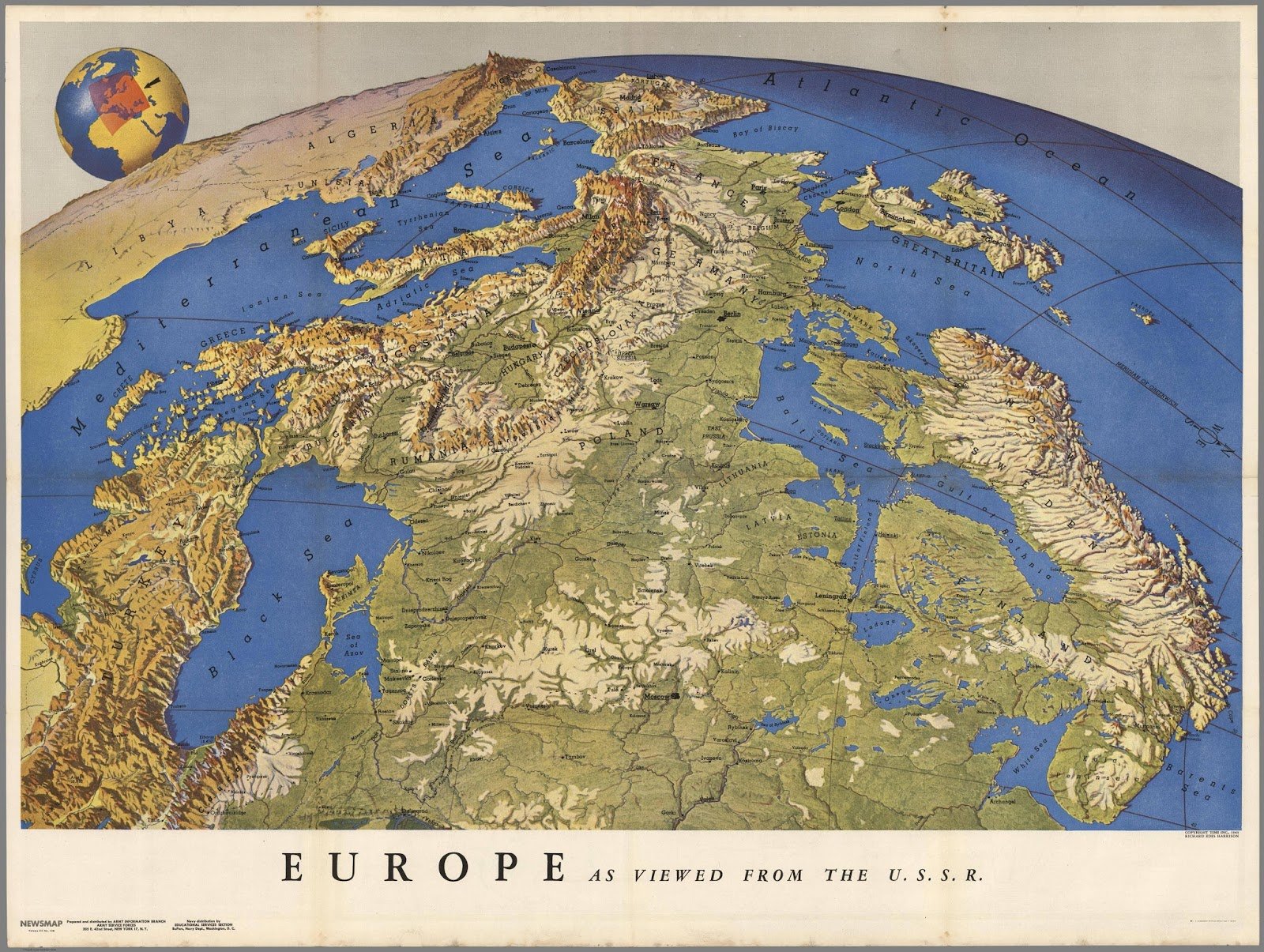 (2017)
The Library of Babel is a short story written by Argentine author Jorge Luis Borges and was published in 1941. The library comprises a gigantic collection of books, each having 410 pages, with 40 lines on each page and 80 characters on each line. Thus, there are 410 x 40 x 80 = 1,312,000 characters in each book. The library contains every possible book of this form, that is, one book with each of the possible orderings of the characters. Borges used an alphabet of 25 letters, so the total number of books is 25 raised to the power 1,312,000. This corresponds approximately to two followed by 1.8 million zeros, an unfathomable number. Thus, it would contain every book that ever has been written, and every book that ever could be, including every play, every song, every scientific paper, every legal decision, every constitution, every piece of scripture, and so on. (2019)
Unlike the Nazi genocide, much of the killing in Galicia in Eastern Europe took place between neighbour and neighbour: Jews, Poles and Ukrainians destroyed each other with increasing ferocity and brutality between 1914 and the 1940s. The beautiful city of Buczacz in Eastern Galicia, with its Roman Catholic, Greek Orthodox and Jewish shrines, ended as a gigantic ruin. Omer Bartov, the distinguished military historian, came from a family that had lived in Buczacz but emigrated to Israel. He begins by explaining that the Jews did not live segregated from the Christian population; the entire notion of a shtetl existing in some sort of splendid (or sordid) isolation is merely a figment of Jewish literary and folkloristic imagination. Integration was what made the existence of such towns possible. It was also what made the genocide there, when it occurred, a communal event, both cruel and intimate, filled with gratuitous violence and betrayal as well as flashes of altruism and kindness. The Spectator (2018)
Saliente-se que, nesse requerimento da providência cautelar, o advogado do jornal da Sonae garantiu que “a omissão do nome da página do Facebook ou do jornal que a alimenta foi uma decisão deliberada da Direcção Editorial do jornal PÚBLICO e da editora da secção da Sociedade que, com sentido de responsabilidade, não quiseram dar publicidade à publicação que, manifestamente, tinha tomado posições claramente atentatórias contra a necessidade de se criar consenso social em favor da vacinação, algo que o jornal assumiu e defendeu desde a primeira hora”. PÁGINA UM (2022)
Times change, but we don’t.
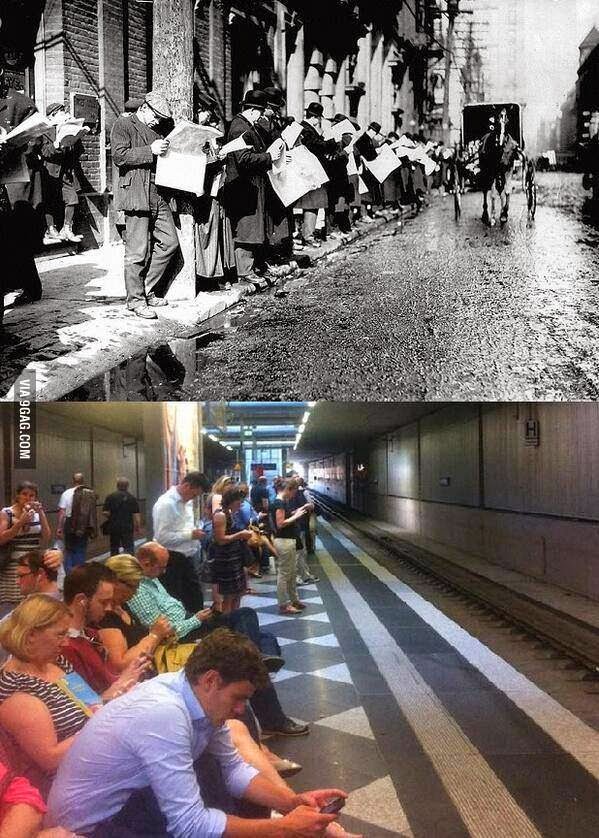 (2014)
The Fixed Period has been so far discussed as to make it almost unnecessary for me to explain its tenets, though its advantages may require a few words of argument in a world that is at present dead to its charms. It consists altogether of the abolition of the miseries, weakness, and fainéant imbecility of old age, by the prearranged ceasing to live of those who would otherwise become old. Need I explain how extreme are those sufferings, and how great the costliness of that old age which is unable in any degree to supply its own wants? Such old age should not be allowed to be. This should be prevented, in the interests both of the young and of those who do become old when obliged to linger on after their “period” of work is over. Oh, it is an adamantine law to protect the human race from the imbecility, the weakness, the discontent, and the extravagance of old age! [Anthony Trollope (1882), The Fixed Period]
In my new book, Supernormal Stimuli: How Primal Urges Overran Their Evolutionary Purpose, I describe how human instincts, for food, sex, or territorial protection, developed for life on the Savannah 10,000 years ago, not today's world of densely populated cities and technological innovations. Evolution has been unable to keep pace with the rapid changes of modern life. In the 1930s Dutch Nobel laureate Niko Tinbergen found that birds that lay small, pale blue eggs speckled with grey preferred to sit on giant, bright blue plaster dummies with black polka dots. He coined the term "supernormal stimuli" to describe these imitations that appeal to primitive instincts and, oddly, exert a stronger attraction than real things. We humans can produce our own supernormal stimuli: candy, pornography, huge-eyed stuffed animals. The concept of Supernormal Stimuli has enormous power to illuminate the alarming disconnect between human instinct and our created environment. [Deirdre Barrett (2010)]
Guys, unless you are really hot you are probably better off not wasting your time on Tinder.
This study was conducted to quantify the Tinder socio-economic prospects for males based on the percentage of females that will "like" them.
It was determined that the bottom 80% of men (in terms of attractiveness) are competing for the bottom 22% of women and the top 78% of women are competing for the top 20% of men.
In addition, it was determined that a man of average attractiveness would be "liked" by approximately 0.87% (1 in 115) of women on Tinder.
Medium (2015)
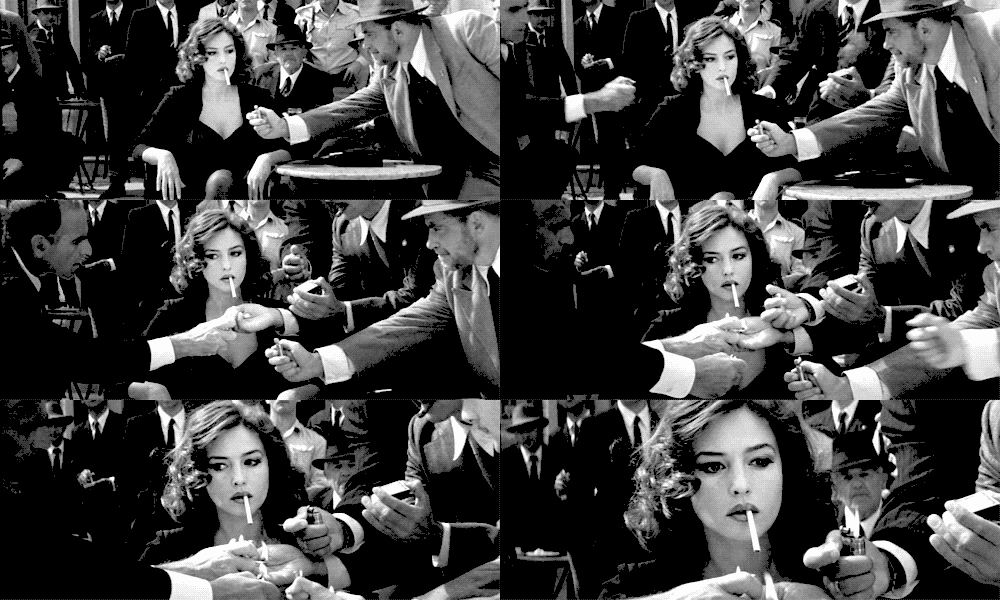
“But really, though, what are you good at?”
“Nothing special. I have things I like to do.”
“For instance?”
“Hiking. Swimming. Reading.”
“You like to do things alone, then?”
[Norwegian Wood (1987), Haruki Murakami]
[O Império e As Províncias]
Vítor Constâncio recusa-se a responder perante os deputados da Comissão de Inquérito ao Banif.
O vice-governador do Banco Central Europeu justifica a opção, dizendo que a instituição com sede em Frankfurt não “presta contras” aos parlamentos nacionais.
Apenas ao “Parlamento Europeu”.
Diário de Notícias (2016)
O Presidente da República desvalorizou as críticas do Conselho de Finanças Públicas.
Para Marcelo Rebelo de Sousa a palavra que importa é de Bruxelas, já que “o Conselho de Finanças Públicas [que duvida das contas do Governo] é um órgão muito importante, mas verdadeiramente importante é a Comissão Europeia”.
Diário de Notícias (2016)
O Benfica foi o primeiro clube português a ganhar um grande troféu na Europa, a Taça dos Clubes Campeões Europeus em 1961 e 1962 (e perdeu as finais de 1963, 1965, 1968, 1988 e 1990 - em 1983 perdeu a final da Taça UEFA e em 2013 e 2014 as finais da Liga Europa). O Benfica era “O” clube português na Europa, a bandeira de Portugal, o que ajuda a explicar o enorme apoio vermelho de norte a sul de Portugal, nas ilhas e também nas colónias africanas (até 1975 e depois). Este estatuto do Benfica começou a ser disputado pelo Futebol Clube do Porto ao ganhar a sua Taça dos Clubes Campeões Europeus em 1987 e no século XXI ao torna-se mesmo no clube com mais sucesso internacional em Portugal ao ganhar a Taça UEFA (2003), a Liga dos Campeões (2004) e a Liga Europa (2011). Como consequência, o estatuto do Benfica como o clube de Portugal na Europa é agora partilhado, e disputado, com o Porto. A hegemonia do Benfica na Europa era refletida também a nível nacional até ao início do século XXI: em 1991 tinha 29 títulos de campeão nacional de futebol e o Porto 11. Em 2022, o Benfica tem 37 títulos e o Porto 30. O crescimento do Porto quer na Europa, quer em Portugal, coloca agora o mesmo como clube que se projeta a nível nacional e não apenas no Porto e no Norte, a raiz histórica da sua identidade. A ascensão do Porto em Portugal e na Europa tem mesmo um paralelismo com a ascensão do Benfica até 1990. (2022)
 (2017)
In one talk held in 2009, a trustee of the Islamic Forum of Europe (IFE) told the recruits: “Our goal is to create the True Believer, [and] to then mobilise these believers into an organised force for change who will carry out dawah [preaching], hisbah [enforcement of Islamic law] and jihad. This will lead to social change and Iqamatud-Deen [an Islamic social and political order].” Another IFE document said: “IFE’s primary work is in Europe because it is this continent, despite all the furore about its achievements, which has a moral and spiritual vacuum.” The Telegraph (2010)
10 de julho de 2014 - o Banco de Portugal reafirma: "A situação de solvabilidade do BES é sólida"
Jornal de Negócios (2014)
3 de agosto de 2014 - o Banco de Portugal aplicou ao BES uma medida de resolução, prevista no art. 145.º-C
Banco Espírito Santo (2015)
Too many jobs in a short time? Unstable candidate.
Too many years at the same company? Inflexible to change.
Too many different types of jobs? Candidate doesn’t know what he wants.
 (2014)
Nietzsche faz a distinção entre três utilizações da História: a arqueológica, a monumental e a crítica. Enquanto a História arqueológica procura preservar o passado e a História monumental deseja emulá-lo, a História crítica pretende libertar o presente das suas reivindicações. Essas três utilizações da História são identificadas com três atitudes: a histórica, a supra-histórica e a não histórica, respectivamente. Para Nietzsche, a atitude histórica tornou-se uma doença histórica (a ruminação interminável do passado) e necessita dos antídotos da supra-histórica (uma orientação para os exemplos eternamente válidos do passado) e não histórica (um esquecimento deliberado do passado nos interesses do presente) para manter aquilo a que ele chama a "higiene da vida". [baseado na introdução ao A Genealogia da Moral de Friedrich Nietzche das Publicações Europa-América (2002)]
Early humans killed animals using a technique known as “persistence hunting” as they literally chased down their dinner. The chase began when a group of hunters separated a large bull from the herd. Once the animal was isolated, a single hunter began the hunt, keeping a steady pace as the animal leaped ahead in fear. When the bull stopped to catch his breath, the hunter closed in, not to catch it but to ran it to exhaustion. After being tracked for a sweltering eight hours under the sun, the beast gave up and collapsed in surrender with barely a struggle. Our ability to maintain steady pursuit gave us the capacity to hunt large prehistoric game. Persistence hunting was not only made possible because of our physical bodies; changes in our brains also played a significant role. The way we evolved to hunt wild game may help explain why we feel compelled to use certain products today. During the chase, the runner is driven by the pursuit itself; this same mental hard-wiring also provides clues into the source of our insatiable desires today that keeps us wanting and buying more and more. Where we once hunted for food, today we hunt for other things. [Hooked (2019), Nir Eyal]
A MSc to rule them all.
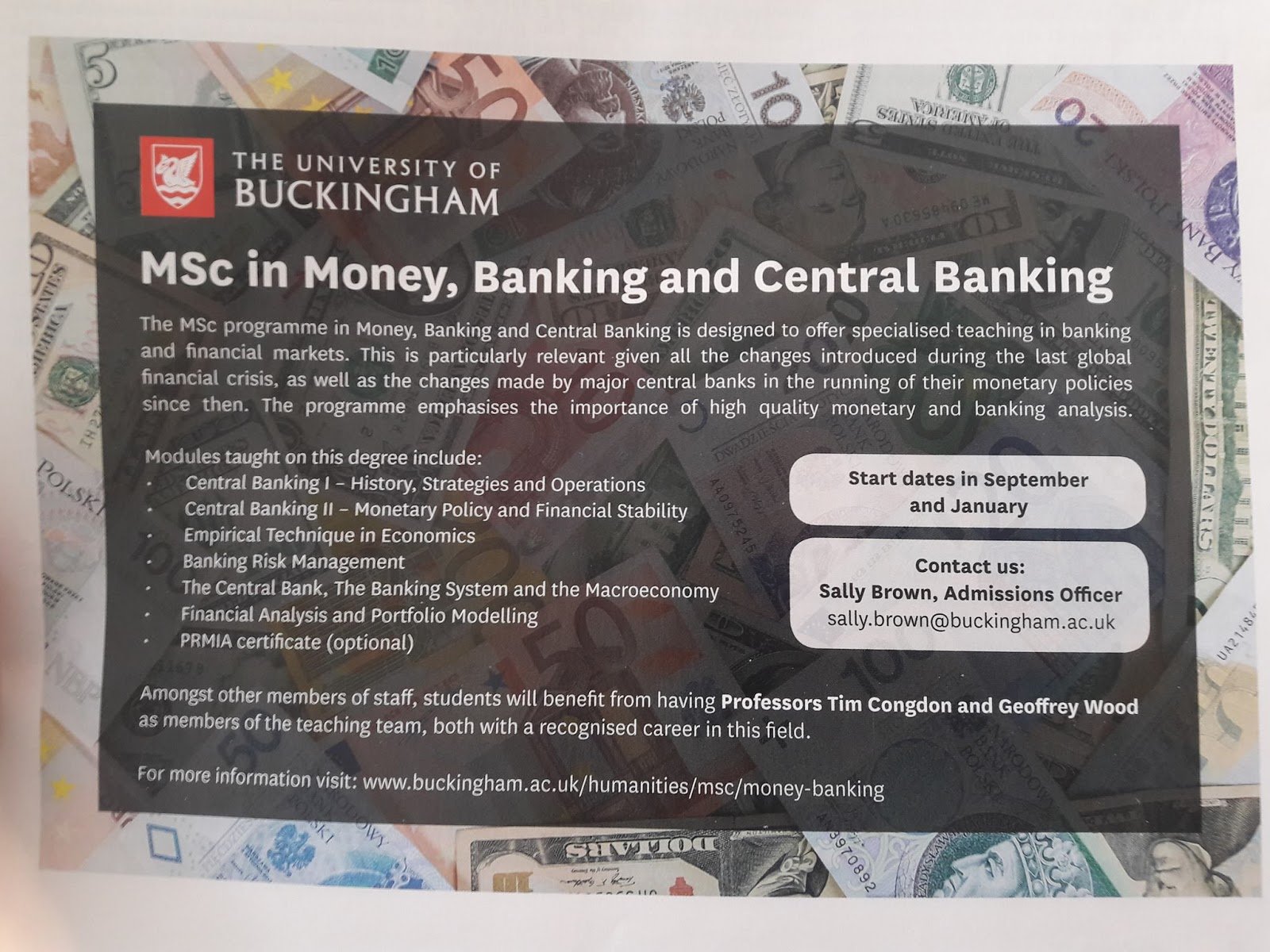 (2017)
“É bom que pensemos que, dos quatro medalhados, três são de origem direta ou indireta africana: um afro-cubano português [Pedro Pichardo], uma angolana portuguesa [Patrícia Mamona], outro são-tomense português [Jorge Fonseca]. Isto mostra que realmente Portugal é grande quando consegue a integração efetiva daqueles que de fora vêm, cá nasceram ou não nasceram cá e cá chegaram no decurso das suas vidas. Quero também invocar hoje Nélson Évora. Nascido na Costa de Marfim, de origem cabo-verdiana, campeoníssimo que recordamos hoje como antecessor de Pedro Pablo Pichardo. Isto é a força de Portugal. Quando de vez em quando encontramos o nosso país ainda tantos que, aberta ou veladamente, têm na cabeça fantasmas de discriminação étnico-racial, é bom que pensem que quando se orgulham com medalhas das Olimpíadas, essas medalhas são devidas a todos eles, portugueses hoje, mas de várias origens, de várias etnias”, afirmou o Presidente da República, Marcelo Rebelo de Sousa. “Esta é uma mensagem forte de alegria por esta delegação olímpica, mas também de orgulho português — mas de orgulho português não xenófobo, não racista, não limitativo, mas abrangente. É essa a riqueza de Portugal. Temos é de fazer avançar esta riqueza noutros domínio onde tem sido mais difícil fazer chegar ao topo aqueles que vêm de origens diversas daquelas que muitas vezes são consideradas como as únicas verdadeiramente nacionais.” Para Marcelo, essa é uma “discussão menor” e “uma forma de xenofobia, uma forma de racismo, uma forma de discriminação, de uma maneira ou de outra, acharmos que bons são só os brancos, são só os nacionais de origem, e não aqueles que são de outras origens, tendo nascido ou não no território nacional”. Observador (2021)
In the early eighties, Pepsi ran a marketing campaign where they touted the success of their product over Coca-Cola in blind taste tests. They called this “The Pepsi Challenge”. Psychologists had already determined you choose your favorite products often not by their inherent value, but because the marketing campaigns and logos and such have cast a spell over you called brand awareness. People liked Coca-Cola’s advertising more than Pepsi’s, so even though they taste pretty much the same, when they saw that bright red can with a white ribbon people chose Coke. So for the Pepsi Challenge, they removed the logos. At first, the researchers thought they should put some sort of label on the glasses. So they went with M and Q. People said they liked Pepsi, labeled M, better than Coke, labeled Q. Irritated by this, Coca-Cola did their own study and put Coke in both glasses. Again, M won the contest. It turned out it wasn’t the drink; people just liked the letter M better than the letter Q. [You Are Not So Smart (2011), David McRaney]
Don’t Let Perfection Be the Enemy of Productivity: Good Enough, Move On.
 (2022)
[Anhedonia] In the simplest of terms, anhedonia is the inability to experience pleasure while participating in pleasurable activities. Some doctors will describe hedonic capacity as the total amount of pleasure that someone is able to gain from a single activity. People who experience anhedonia will often describe themselves as not having the desire or motivation to do anything. Studies suggest that there is a link between individuals who experience anhedonia and the concept of reward. Because of the fact that they cannot see the reward at the end of the road, they lack to motivation to get there. Often without conscious input, our brain is constantly making choices regarding risk, reward, payoff, etc. If the brain does not see the reward or payoff, it will not want to move forward with a risk or participating in goal-directed behavior. (2020)
In The Scramble for Europe (2019), Stephen Smith focuses on 'young Africa' – 40 per cent of its population are under fifteen – and a dramatic demographic shift. Today, 510 million people live inside EU borders, and 1.25 billion people in Africa. In 2050, 450 million Europeans will face 2.5 billion Africans. The demographics are implacable. The scramble for Europe will become as inexorable as the 'scramble for Africa' was at the end of the nineteenth century, when 275 million people lived north and only 100 million lived south of the Mediterranean. If Africa's migratory patterns follow the historic precedents set by other less developed parts of the world, in thirty years a quarter of Europe's population will be Afro-Europeans. (2018)
The technical prostheses that amplify manifold the organismic mobility of the human animal come to determine the space-consciousness of this animal at the current historical and evolutionary stage of its development.
[Michael Marder (2022), Philosophy for Passengers]
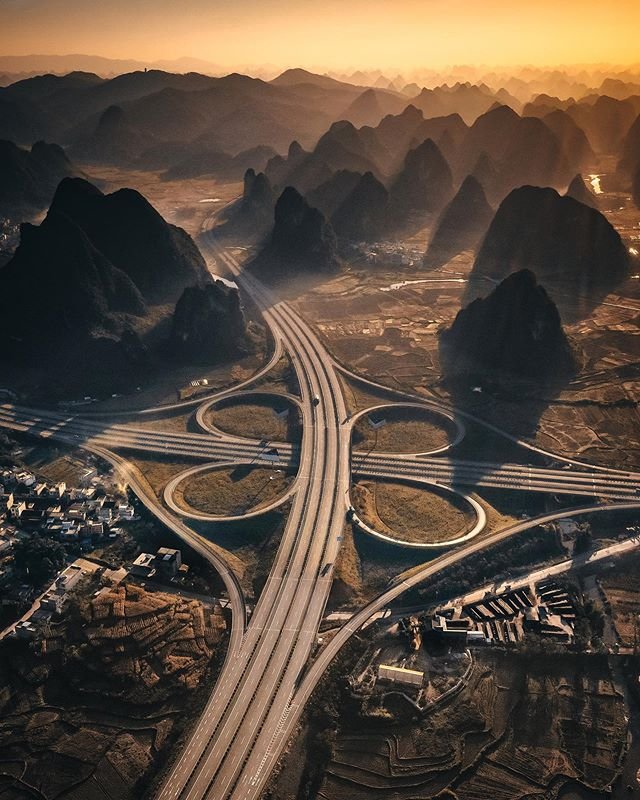 Guangxi, China
America is already headed toward a metropolis-first arrangement. The states aren’t about to go away, but economically and socially, the country is drifting toward looser regional formations, anchored by the great cities and urban archipelagos that already lead global economic circuits. Federal policy should refocus on helping these nascent archipelagos prosper, and helping others emerge, collectively forming a lattice of productive metro-regions efficiently connected through better highways, railways and fiber-optic cables: a United City-States of America. Similar shifts can be found around the world; despite millenniums of cultivated cultural and linguistic provinces, China is transcending its traditional internal boundaries to become an empire of 26 megacity clusters with populations of up to 100 million each, centered around hubs such as Beijing, Shanghai, Guangzhou and Chongqing-Chengdu. The New York Times (2016)
Ah, os paquetes, os navios-carvoeiros, os navios de vela!
Vão rareando — ai de mim! — os navios de vela nos mares!
E eu, que amo a civilização moderna, eu que beijo com a alma as máquinas,
Eu o engenheiro, eu o civilizado, eu o educado no estrangeiro,
Gostaria de ter outra vez ao pé da minha vista só veleiros e barcos de madeira,
De não saber doutra vida marítima que a antiga vida dos mares!
Porque os mares antigos são a Distância Absoluta,
O Puro Longe, liberto do peso do Actual…
E ah, como aqui tudo me lembra essa vida melhor,
Esses mares, maiores, porque se navegava mais devagar.
Esses mares, misteriosos, porque se sabia menos deles.
[Ode Marítima, Álvaro de Campos (1915), Fernando Pessoa]
Never Ending Inertia
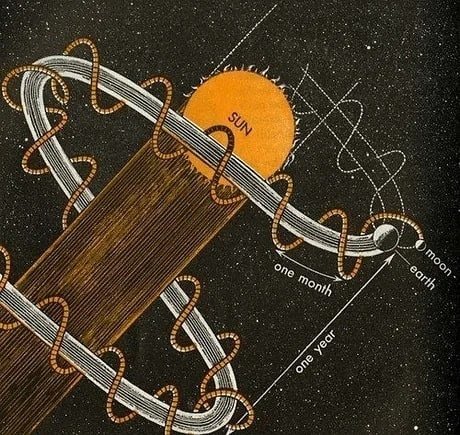 (2019)
The building blocks required to achieve success in a business domain and differentiate the company from its competitors:
- Core domains: The interesting problems. These are the in-house activities the company is performing differently from its competitors and from which it gains its competitive advantage.
- Generic domains: The solved problems. These are the things all companies are doing in the same way. There is no room or need for innovation here; rather than creating in-house implementations, it’s more cost-effective to adopt \ buy existing solutions.
- Supporting domains: The problems with obvious solutions. These are the activities the company likely has to implement in-house or outsourced, but that do not provide any competitive advantage.
(2023)
On 2019, Nobel laureate and discoverer of the double-helix DNA structure James Watson was stripped of all his academic titles. This reprisal was undertaken by his former colleagues at Cold Spring Harbour Laboratory and came as a reaction to his latest remarks on the possible genetic connection between race and IQ. Dr. Watson’s opinions came to light again in a recent PBS documentary entitled American Masters: Decoding Watson. In the documentary he is asked whether his views about the relationship between race and intelligence have changed. “No,’’ Dr. Watson said. “Not at all. I would like for them to have changed, that there be new knowledge that says that your nurture is much more important than nature. But I haven’t seen any knowledge. And there’s a difference on the average between blacks and whites on IQ tests. I would say the difference is, it’s genetic.’’ This is not the first time Watson has made headlines for his views. In 2007 he gave an interview with the Sunday Times in which he stated that he was “inherently gloomy about the prospect of Africa.” He furthermore states that “all our social policies are based on the fact that their intelligence is the same as ours, whereas all the testing says not really.” The Burkean (2019)
The Soup
 (2019)
Os japoneses fazem com qualquer insignificância um faustoso embrulho. É precisamente uma especialidade do embrulho japonês que a futilidade da coisa não tenha nenhuma relação com o requinte da embalagem. Em termos semióticos: o significante (o invólucro) é mais importante do que aquilo que denota, o significado, o conteúdo. O embrulho japonês não revela nada, faz que o olhar se desvie do conteúdo e remete-o em primeiro lugar para o magnífico envoltório. Também o quimono cobre o corpo com um excesso de significantes, num jogo de cores e formas. O corpo, como portador de significantes, opõe-se ao corpo pornográfico, que se mostra sem nenhum véu e que por isso é obsceno. O corpo pornográfico, que está despojado de significante, remete apenas para o significado nu, para a nua verdade, ou seja, para o sexo. [Byung-Chul Han (2019), Do Desaparecimento dos Rituais]
Segundo os números mais recentes da Pordata em 2016, existem em Portugal mais de 3,6 milhões de pensionistas. Mais de 650 mil funcionários públicos. Outros tantos desempregados. Perto de 300 mil beneficiários do rendimento social de inserção. Somando estes quatro números deparamo-nos com 5,2 milhões de pessoas. E se a estes 5,2 milhões somarmos filhos menores e familiares dependentes, ultrapassamos facilmente os 6 milhões que Medina Carreira costuma citar com regularidade. Fixem bem o número, porque ele é o mais importante para explicar Portugal e a sua paralisia: num país com 10 milhões de habitantes, pelo menos 6 milhões beneficiam de transferências directas do Estado central. Público (2016)
Endowed with a pure understanding, restraining the self with firmness, turning away from sound and other objects, and abandoning love and hatred; dwelling in solitude, eating but little, controlling the speech, body, and mind, ever engaged in meditation and concentration, and cultivating freedom from passion; forsaking conceit and power, pride and lust, wrath and possessions, tranquil in heart, and free from ego – he becomes worthy of becoming one with the imperishable.
[Bhagavad Gita, 18:51-53]
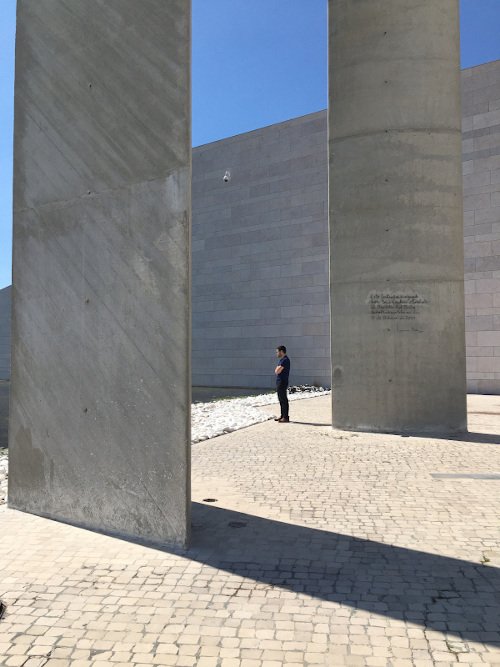 (2020)
X. War And Warriors
Ye shall love peace as a means to new wars – and the short peace more than the long.
You I advise not to work, but to fight. You I advise not to peace, but to victory. Let your work be a fight, let your peace be a victory!
War and courage have done more great things than charity. Not your sympathy, but your bravery hath hitherto saved the victims.
Ye shall only have enemies to be hated, but not enemies to be despised. Ye must be proud of your enemies; then, the successes of your enemies are also your successes.
Resistance – that is the distinction of the slave. Let your distinction be obedience. Let your commanding itself be obeying!
So live your life of obedience and of war! What matter about long life! What warrior wisheth to be spared!
I spare you not, I love you from my very heart, my brethren in war!
Thus spake Zarathustra.
[Friedrich Nietzsche (1891). Thus Spoke Zarathustra: A Book for All and None]
It is possible that some native Europeans may not appreciate an endless amount of diversity in their local schools and may want their children to be educated around people from a similar cultural background. This means, especially if those parents are in an inner-city area or suburb, that they are likely to worry about being able to afford a house in the kind of middle-class neighbourhood from which their child would be in the catchment area of a less diverse school. If they cannot afford to bring up their children in the way in which they would like, many people will fail to have the number of children they would like. [The Strange Death of Europe: Immigration, Identity, Islam (2017), Douglas Murray]
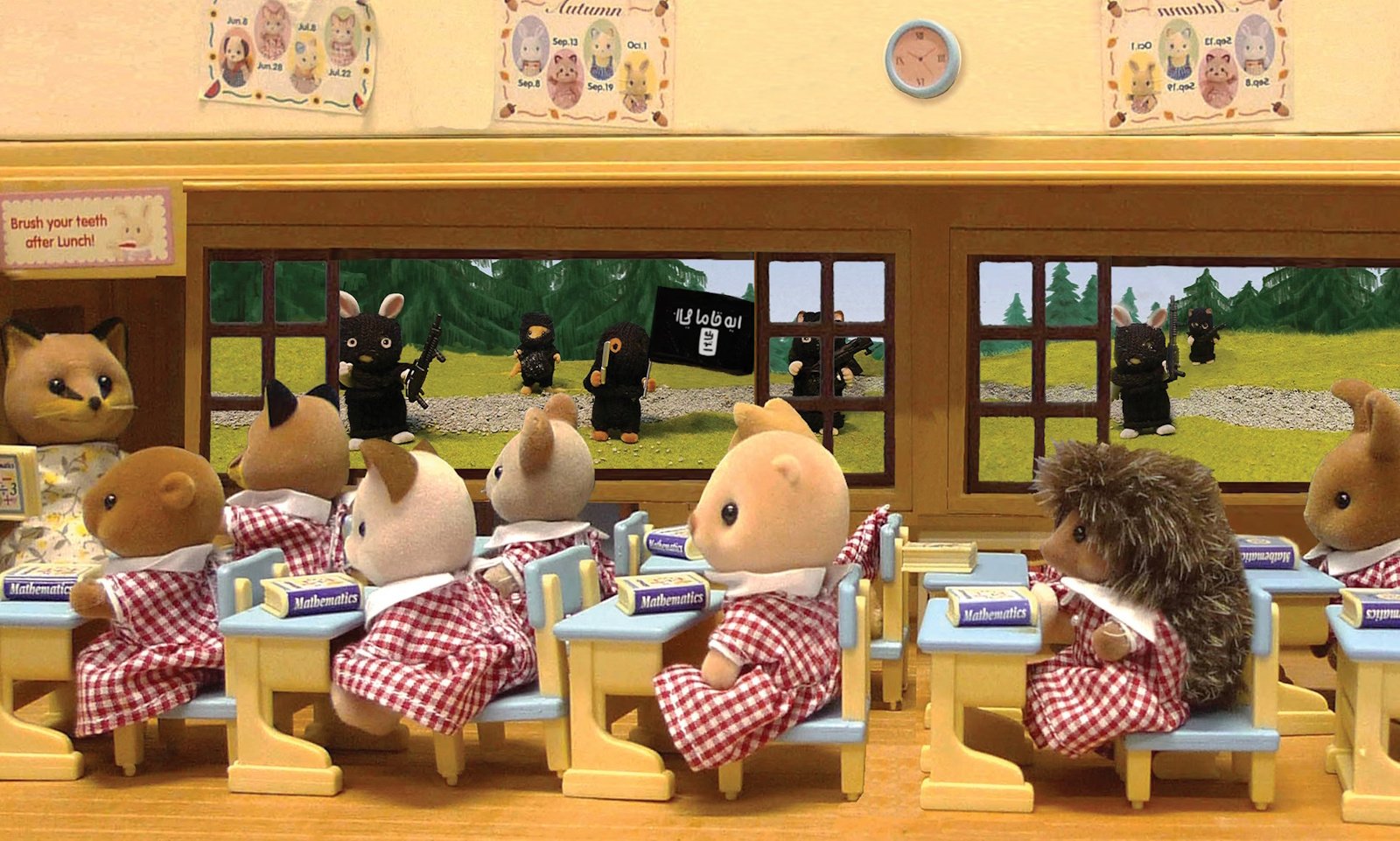
The satire is not on Islamic State so much as on the west, living out our Sylvanian idyll, pretending this is not happening.
The violence of the black-clad terrorists keeps interrupting domestic tranquility and public peace. Girls getting an education are about to be kidnapped.
Violence is about to shatter a day at the beach. All that is missing from these funny yet grisly glimpses of our time is a scene of Sylvanian jihadis demolishing ancient temples.
The Guardian (2015)
António Costa definiu-se este domingo como "meio vizinho da China", numa alusão às origens indianas do seu pai e num discurso em que salientou os carateres pluricontinental do português, enquanto respondia a questões formuladas por estudantes da Universidade de Tsinghua, uma das mais prestigiadas da China. "Posso aliás dar o meu exemplo, porque sou o primeiro primeiro-ministro de um país da União Europeia que tem origem extra europeia, visto que o meu pai era de origem indiana, um país vizinho da China", declarou António Costa. Observador (2016)
After giving yourself these titles: good, self-respecting, true, sane, conforming, high-minded, take care not to get others in their place; and, if you do lose these titles, be quick to return to them. Adventure yourself then upon these few titles, and if you are able to abide in them, abide like a man translated to Islands of the Blest; but if you perceive that you are falling away and losing control, go bravely away into some corner, there to recover control, or even depart altogether from life, not angrily, but simply and freely and with self-respect, having done at least this one thing in life, to have made your exit thus. [Marcus Aurelius, The Meditations – Book Ten]
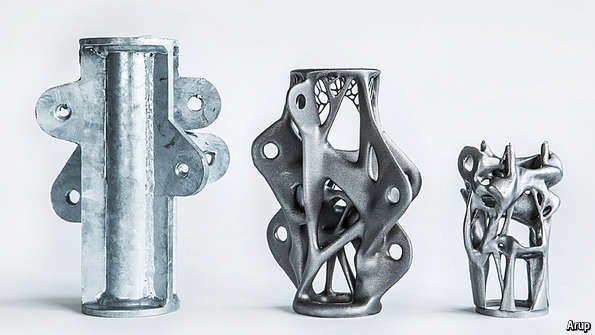
The component on the left was done largely by hand. The other two have been analysed by a computer to find the optimal design that is able to provide the same strength, but from the least amount of material.
The middle component was optimised to keep the fixing points for the arms and cables in much the same place, and resulted in a 40% weight saving.
The third was obtained by allowing the system to completely rejig the entire structure. It produced a 75% weight saving.
The Economist (2015)
Deputados por regiões, para quando? Os deputados da Assembleia da República são eleitos por círculos eleitorais geograficamente definidos na lei, mas serão eles verdadeiros defensores dos interesses das regiões que representam? Não, até porque grande parte nem sequer é natural das mesmas e, durante o mandato, não as auscultam nem residem lá. Nas legislativas de 2015 Teresa Caeiro chegou a pedir "desculpa" à distrital do CDS/Algarve por ser candidata a deputada: "Desculpem lá o ambiente que eu vim causar. Também não tive culpa de ser nomeada pelo Paulo Portas para a lista de Faro." Público (2017)
Of all the information that every second flows into our brains from our sensory organs, only a fraction arrives in our consciousness: the ratio of the capacity of perception to the capacity of apperception is at best a million to one. A million times more bits enter our heads than consciousness perceives. Consciousness lags behind what we call reality. It takes half a second to become conscious of something, though that is not how we perceive it. Outside our conscious awareness, an advanced illusion rearranges events in time. Our consciousness lags behind because it has to present us with a picture of the surrounding world that is relevant. But it is precisely a picture of the surrounding world it presents us with, not a picture of all the superb work the brain does. The sequence is: sensation, simulation, experience. But it is not relevant to know about the simulation, so that is left out of our experience, which consists of an edited sensation that we experience as unedited. What we experience directly is an illusion, which presents interpreted data as if they were raw. It is this illusion that is the core of consciousness: the world experienced in a meaningful, interpreted way. What we experience has acquired meaning before we become conscious of it. [Tor Nørretranders, The User Illusion (1999)]
Hitler dismissed a return to the boundaries of 1914 as a false goal for Germany, because boundaries are arbitrary: one is not morally entitled to them, one simply takes them if one can.
“The reality of a nation having managed a disproportionate acquisition of territory is no superior obligation for its eternal recognition.
It proves at most the might of the conqueror and the weakness of the victim.
And, moreover, this might alone makes it right,” Hitler wrote.
[Justice and the Genesis of War (1995), David A. Welch]
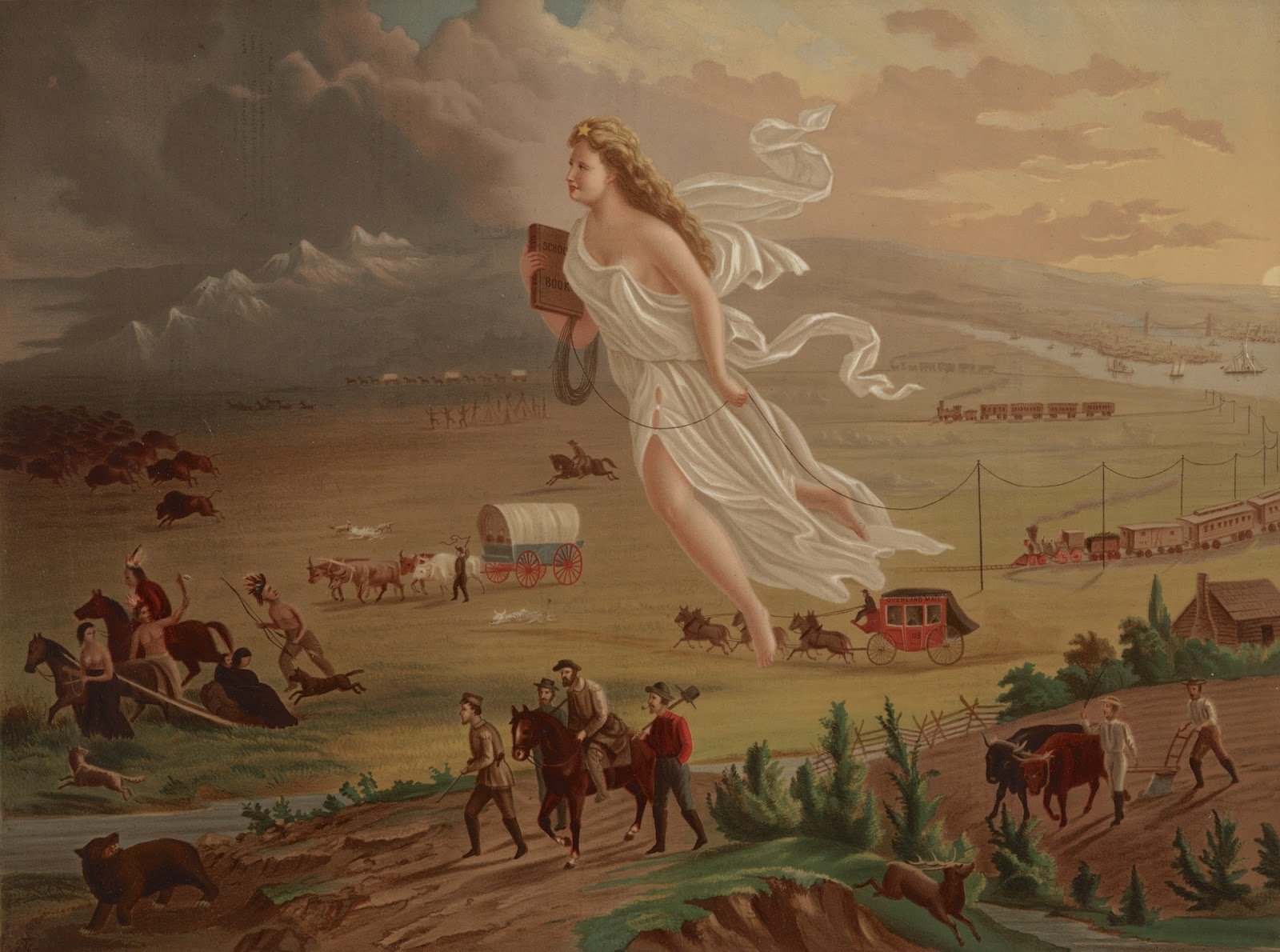 American Progress (1872), John Gast